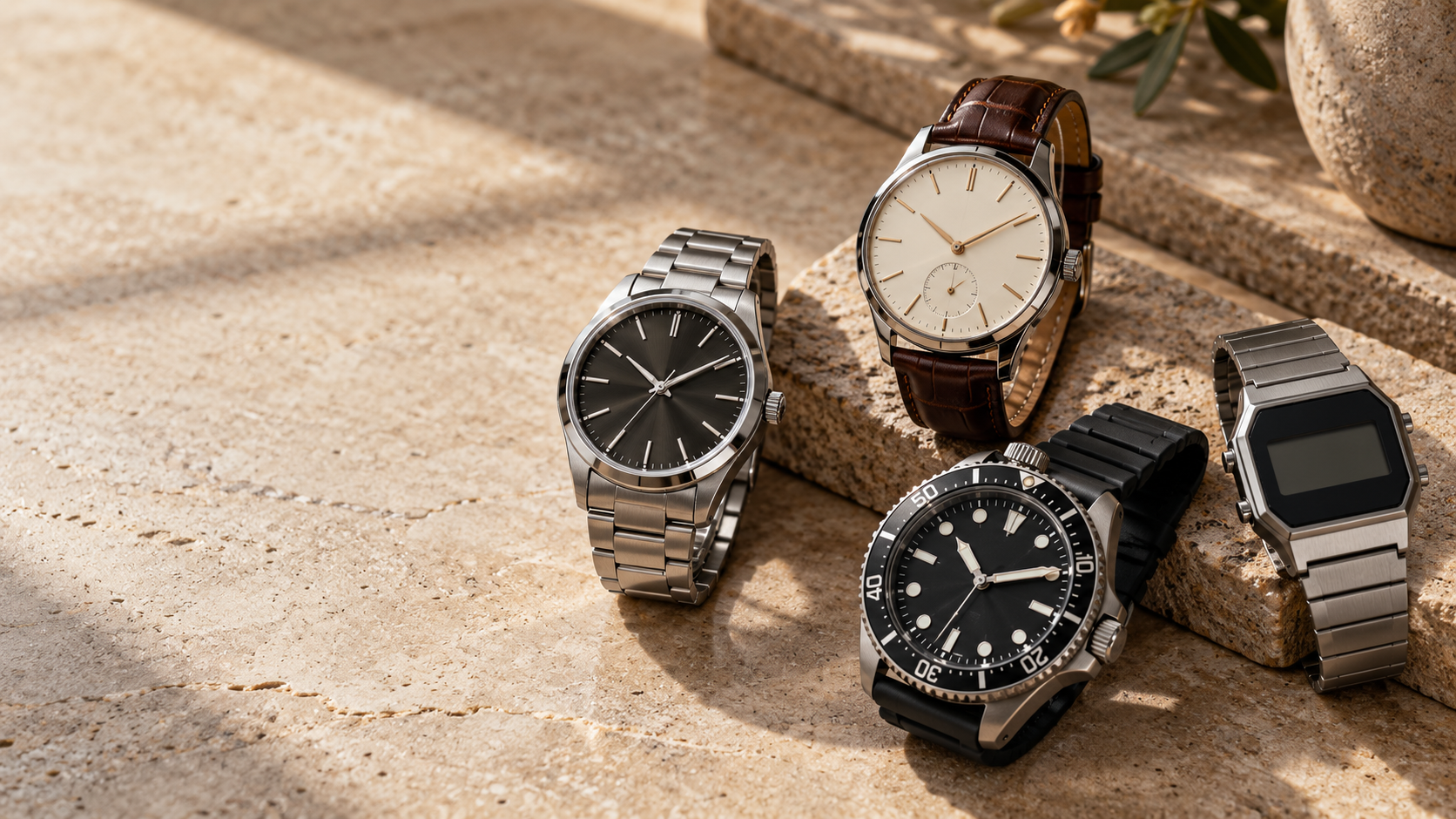
The good news is that you do not need to become a watch expert before buying one. You simply need to understand a few important factors and match them to your wrist, lifestyle, wardrobe, and budget.
This guide explains how to choose a watch for men, including watch types, case size, wrist fit, automatic versus quartz movements, water resistance, crystal materials, straps, complications, budgets, and the questions buyers commonly ask before purchasing.
Quick Answer: How Do You Choose a Watch for Men?
The simplest approach is to choose your watch in this order:
- Set your budget.
- Decide how you will wear it.
- Measure your wrist and choose an appropriate case size.
- Choose a movement: quartz, automatic, mechanical, or solar.
- Select the watch style.
- Check water resistance and materials.
- Choose the strap or bracelet.
- Compare comfort, legibility, maintenance, warranty, and overall value.
Starting with these practical factors is usually more useful than choosing a watch simply because it is popular or looks impressive in a photograph.
What Should You Look for in a Watch for Men?
The most important thing to remember is that there is no single watch that is right for every man. The best choice depends on what you need the watch to do.
For an office environment, you might prioritize a slim case, clean dial, comfortable bracelet, or leather strap. For outdoor activities, durability, legibility, shock resistance, and water resistance may matter more. For formal occasions, a thin dress watch can work better than a large sports watch.
When comparing men’s watches, pay particular attention to:
- Case diameter and lug-to-lug length
- Case thickness
- Movement type
- Water resistance
- Crystal material
- Case and bracelet materials
- Dial readability
- Strap or bracelet quality
- Complications and additional functions
- Warranty and after-sales service
- Maintenance requirements
- Price relative to your budget
Current men’s watch buying guides commonly organize the decision around purpose, fit, movement, materials, and price rather than appearance alone. r2
What Is the Best Watch for Men?
There is no universally best watch for men. The right watch depends on your lifestyle, wrist size, budget, personal taste, and intended use.
For example, a man who wants a low-maintenance everyday watch may prefer quartz or solar technology. Someone who appreciates traditional watchmaking may prefer an automatic mechanical watch. A frequent traveler may value a GMT function, while someone who spends time in the water may want a purpose-built dive watch.
Instead of asking “What is the best men’s watch?”, a more useful question is:
“What watch best fits the way I live?”
That change in approach can dramatically narrow your choices.
How Do You Choose the Right Watch Style for Men?
Start by thinking about where you will wear the watch most often. Men’s watches generally fall into several broad categories.
Dress Watches
Dress watches are typically slimmer and more understated. They often feature simple hour markers, relatively thin cases, and leather straps or refined bracelets.
A dress watch works well with suits, business clothing, weddings, dinners, and other formal occasions.
Field Watches
Field watches are inspired by practical military and outdoor designs. They tend to prioritize clear numerals, strong legibility, simple layouts, and durable construction.
They can be excellent everyday watches because their styling works with casual clothing as well as many business-casual outfits.
Dive Watches
Dive watches are designed around underwater use and typically feature strong water resistance, luminous displays, and a rotating timing bezel.
Even if you never dive, their robust construction and sporty appearance make them popular everyday watches.
Chronograph Watches
A chronograph is a watch with a stopwatch function. Chronographs often have additional sub-dials and pushers on the case.
They can be practical if you regularly time events, but many people choose them primarily because they enjoy the technical appearance.
GMT Watches
A GMT watch is designed to display an additional time zone. It can be particularly useful for frequent travelers, international business, or anyone who regularly communicates with people in another time zone.
Sports Watches
Sports watches generally prioritize durability, readability, water resistance, and comfortable everyday wear. Depending on the design, they can work for exercise, travel, weekends, or casual office environments.
Smartwatches
Smartwatches are a different category because they combine timekeeping with functions such as notifications, fitness tracking, navigation, calls, apps, and health-related measurements.
If you mainly want traditional watchmaking, materials, and long-term mechanical ownership, a conventional wristwatch may be more appropriate. If connectivity and activity tracking are your priorities, a smartwatch may make more sense.
What Watch Size Should a Man Wear?
Watch size should be determined by your wrist, the watch’s proportions, and your personal preference—not simply by a “men’s size” label.
Case diameter is useful, but it is not the whole story. Two watches with the same diameter can wear very differently because of differences in lug-to-lug length, thickness, bezel design, dial size, case shape, and bracelet construction.
Modern watch sizing guides increasingly emphasize looking at the complete case rather than relying on diameter alone. r3
| Approximate wrist circumference | Common case-size starting point | Typical impression |
|---|---|---|
| Under 16 cm | 34–38 mm | Compact and understated |
| 16–17 cm | 36–40 mm | Balanced and versatile |
| 17–18.5 cm | 38–42 mm | Versatile everyday range |
| 18.5–20 cm | 40–44 mm | Larger, more substantial presence |
| Over 20 cm | 42–46+ mm | Larger cases may be proportionate |
These are starting points rather than strict rules. A 38 mm field watch and a 38 mm dress watch can have completely different visual proportions.
How Do You Measure Your Wrist for a Watch?
Use a flexible measuring tape around the wrist where you normally wear your watch. If you do not have a measuring tape, wrap a piece of string or paper around your wrist and then measure it against a ruler.
For a more complete fit assessment, measure the width of the top of your wrist as well. Wrist circumference helps you estimate overall proportions and strap length, while wrist width can help you understand how the case and lugs will sit across your arm.
When buying online, look for three measurements:
- Case diameter: the width of the case, normally excluding the crown.
- Lug-to-lug: the distance from one end of the lugs to the other.
- Case thickness: how far the watch rises from your wrist.
Checking all three can give you a much better idea of how a watch will wear than case diameter alone.
Is a 40mm Watch Good for Men?
Yes. A 40mm watch can be a highly versatile choice for many men, but 40mm is not automatically the correct size for every wrist.
The overall proportions matter. A 40mm watch with short lugs and a compact dial can wear smaller than a 40mm watch with long lugs and a wide bezel.
If you are buying your first traditional watch and do not know where to begin, comparing watches around the 38–42mm range can provide a useful starting point. Try to judge the actual measurements and wrist fit rather than assuming a particular number is universally correct.
Is a 42mm Watch Too Big for Men?
Not necessarily. A 42mm watch can look perfectly proportioned on a larger wrist, particularly when its lug-to-lug measurement and thickness are well balanced.
However, a 42mm sports watch and a 42mm dress watch can feel very different. Large complications, thick bezels, tall cases, and long lugs can make a watch appear significantly larger.
The most important test is whether the lugs extend beyond the sides of your wrist and whether the watch feels comfortable during normal movement.
Should a Watch Lugs-to-Lugs Extend Beyond Your Wrist?
Ideally, the lugs should not dramatically overhang the sides of your wrist. When the lugs extend substantially beyond the wrist, the watch can feel visually oversized and may be less comfortable.
That does not mean every watch must fit within an exact measurement. Curved lugs can wrap around the wrist differently from straight lugs, and wrist shape varies considerably.
If you are shopping online, compare the watch’s lug-to-lug length with the width of your wrist rather than looking only at the advertised diameter.
What Is Better: Quartz or Automatic Watches?
Neither movement is universally better. Quartz and automatic watches offer different ownership experiences.
| Feature | Quartz | Automatic |
|---|---|---|
| Power source | Battery-powered electronic movement | Mechanical movement powered by a mainspring and winding system |
| Accuracy | Generally very high | Varies according to movement and conditions |
| Maintenance | Generally low | Requires mechanical servicing over time |
| Convenience | Very high | Can stop when not worn, depending on power reserve |
| Watchmaking appeal | Focused on practicality and precision | Mechanical craftsmanship is a major attraction |
| Typical buyer | Someone prioritizing accuracy and convenience | Someone interested in mechanical watchmaking |
If you want a watch that you can put on and largely forget about, quartz can be an excellent choice. If you enjoy mechanical engineering and traditional watchmaking, an automatic watch may be more appealing.
Are Automatic Watches Better Than Quartz Watches?
Automatic watches are not automatically “better” simply because they are mechanical.
An automatic movement can provide the tactile and mechanical experience many watch enthusiasts value. A quartz movement, however, can offer excellent accuracy, convenience, affordability, and low-maintenance ownership.
The better movement is the one that matches what you expect from the watch.
What Is a Mechanical Watch?
A mechanical watch uses a mechanical movement rather than an electronic quartz oscillator. Its energy comes from a wound mainspring, which gradually releases energy through the movement’s regulating system.
Mechanical watches are often purchased for craftsmanship and the appreciation of traditional horology rather than because they are the most convenient method of telling time.
What Is a Solar Watch?
A solar watch uses light to generate energy for its movement. Depending on the technology and model, the watch can use natural or artificial light to maintain its power.
Solar watches can be attractive for buyers who want the convenience of quartz with less dependence on regular battery replacement. Citizen’s Eco-Drive technology, for example, is designed to use light as its power source and states that fully powered watches can run for months in darkness. r4
For many everyday buyers, solar technology is an option worth considering alongside traditional quartz and automatic movements.
How Much Should You Spend on a Watch for Men?
There is no required amount you need to spend. A sensible budget is one that you can afford without compromising other financial priorities.
Rather than assuming an expensive watch is automatically better, consider what you are getting for the additional money.
Under $200
This range can provide reliable quartz, digital, solar, and entry-level mechanical options. Focus on movement reliability, fit, crystal, warranty, and build quality.
$200–$500
This is a broad category with many established brands and a wide variety of quartz, solar, and automatic watches. At this level, compare specifications carefully rather than buying based solely on branding.
$500–$1,000
You will find a wider selection of mechanical watches, improved finishing, sapphire crystals on many models, better bracelets, and more specialized designs.
$1,000–$5,000
This range opens the door to more advanced movements, premium materials, stronger finishing, Swiss and Japanese mechanical watches, and watches with more specialized complications.
Luxury Watches
Once you move into luxury pricing, you are paying for a combination of movement development, finishing, materials, design, heritage, distribution, brand positioning, service infrastructure, and craftsmanship. The relationship between price and practical performance becomes much less straightforward.
Set your maximum budget first. Then compare watches within that limit instead of increasing your budget every time you find something attractive.
What Is the Best Everyday Watch for Men?
An everyday watch should be comfortable, readable, durable enough for your routine, and versatile enough to work with most of your wardrobe.
For many people, a simple three-hand watch with a date, moderate water resistance, and a versatile steel bracelet or interchangeable strap is easier to live with than a highly complicated watch.
Consider how you spend most of your week. If your life involves an office, commuting, casual weekends, travel, and occasional formal events, versatility may be more valuable than a specialized feature you rarely use.
What Water Resistance Should a Men’s Watch Have?
Water resistance should be matched to how you intend to use the watch.
| Typical rating | General use |
|---|---|
| 30 m / 3 ATM | Everyday splashes; check the manufacturer’s instructions |
| 50 m / 5 ATM | More resistance for everyday exposure, but not necessarily intended for serious swimming |
| 100 m / 10 ATM | A common choice for active everyday wear and swimming, subject to manufacturer guidance |
| 200 m / 20 ATM | Appropriate for watches designed for more demanding water use |
| Diver’s watch rating | Look for a watch specifically designed and rated for diving |
Important: water-resistance numbers should not be interpreted as a literal maximum diving depth. The actual rating, testing standard, construction, seals, crown design, age of the watch, and manufacturer’s instructions all matter.
ISO distinguishes ordinary water-resistant watches from diver’s watches and identifies ISO 6425 as the relevant standard for diver’s watches. r5
Can You Swim With a 50m Water-Resistant Watch?
Do not assume that “50m” means you can safely take any watch 50 meters underwater.
Water-resistance ratings are based on controlled testing and should be interpreted according to the manufacturer’s instructions. Swimming creates movement, pressure changes, temperature changes, and other real-world conditions that differ from a static laboratory test.
If swimming is an important part of your lifestyle, choose a watch specifically intended for swimming and follow the manufacturer’s guidance.
What Does 100m Water Resistance Mean on a Watch?
A 100m rating indicates that the watch has been tested for a specified level of water resistance under controlled conditions. It does not simply mean that you can take the watch to a depth of exactly 100 meters.
For practical buying decisions, think of water resistance as one part of the watch’s intended-use specification rather than a literal depth guarantee.
What Is the Best Watch Crystal: Mineral or Sapphire?
The crystal is the transparent material covering the dial. Common choices include acrylic, mineral glass, and sapphire crystal.
Acrylic
Acrylic is lightweight and can be used on vintage-inspired or inexpensive watches. It can scratch more easily, although minor scratches can sometimes be polished out.
Mineral Crystal
Mineral glass offers a balance between cost and durability and is widely used on affordable and mid-range watches.
Sapphire Crystal
Sapphire is highly scratch resistant and is common on many premium watches. It can provide a very clear, durable surface, although sapphire is not completely immune to damage.
If scratch resistance is a high priority, sapphire is an important specification to consider.
Which Is Better: Stainless Steel, Titanium, or Gold?
The case material affects weight, appearance, durability, cost, and how the watch feels on your wrist.
Stainless Steel
Stainless steel is a popular all-purpose choice because it offers durability, a familiar appearance, and broad versatility.
Titanium
Titanium is valued for its low weight and strength. It can be particularly appealing if you dislike the feeling of a heavier watch on your wrist.
Some manufacturers also use proprietary titanium treatments. For example, Citizen describes its Super Titanium material as significantly lighter and harder than conventional stainless steel. r6
Gold
Gold provides a distinctive luxury appearance but is generally softer than many common watch case materials. Gold watches are usually chosen for aesthetics, tradition, and luxury appeal rather than maximum resistance to scratches.
Should You Buy a Leather Strap or Metal Bracelet?
Choose based on your wardrobe, climate, comfort preferences, and intended use.
- Leather: refined, classic, and particularly suitable for dress watches.
- Stainless steel bracelet: versatile, durable, and suitable for many everyday watches.
- Rubber: practical for sporty and water-oriented watches.
- NATO or fabric: casual, lightweight, and easy to replace.
- Titanium bracelet: useful when low weight is a priority.
Also check whether the watch uses a standard lug width and whether replacement straps are readily available. Strap flexibility can make a watch considerably more versatile.
What Color Watch Should a Man Buy?
If you want one watch that works with the largest portion of your wardrobe, neutral colors are generally easier to coordinate.
Black, white, silver, blue, gray, and dark tones can work across many different outfits. Gold-tone watches can create a stronger statement, while brightly colored dials are useful when you specifically want the watch to become a focal point.
Think about the colors you already wear rather than choosing a dial color in isolation.
Is a Black Watch Better Than a Silver Watch?
Neither is inherently better. They create different visual effects.
A black watch can look modern, sporty, understated, or tactical depending on its design. A silver or stainless-steel watch can be more traditionally versatile and can pair easily with a wide range of clothing.
If you are buying your first watch, consider which finish naturally complements your existing shoes, belt, jewelry, and clothing.
What Watch Should a Man Wear With a Suit?
A slim, understated dress watch is a traditional choice with a suit. Look for a relatively thin case, clean dial, restrained complications, and a leather strap or refined bracelet.
The goal is usually balance. A very thick sports watch can compete visually with formal clothing, while an understated watch tends to blend naturally with a tailored outfit.
That said, modern menswear is less rigid than traditional dress codes. Personal style and the formality of the occasion should guide the final decision.
What Watch Should a Man Wear Casually?
For casual wear, you have considerably more freedom. Field watches, dive watches, sports watches, chronographs, everyday automatic watches, digital watches, and simple quartz watches can all work.
Focus on comfort and versatility. If you regularly wear jeans, sneakers, T-shirts, polos, or casual shirts, a sporty or field-style watch may integrate naturally with your wardrobe.
Should a Man Own More Than One Watch?
You do not need more than one watch. A single versatile watch can cover most situations.
However, owning several watches allows you to match different watches to different activities and clothing.
A simple three-watch collection could consist of:
- An everyday watch
- A dressier watch for formal occasions
- A sport, field, or dive watch for weekends and outdoor activities
You can expand from there if collecting genuinely interests you. There is no requirement to build a large collection simply because you enjoy watches.
What Features Actually Matter When Buying a Men’s Watch?
Prioritize features you will actually use.
A date display can be useful every day. A GMT function can be valuable to travelers. A chronograph can be useful for timing events. Luminescent hands and markers can improve nighttime readability. A rotating dive bezel makes sense if you need timing functionality associated with diving.
Complications can also make a watch more visually interesting, but additional features usually increase complexity. Do not pay extra for a function simply because the specification sheet contains it.
What Does a Chronograph Do?
A chronograph is essentially a stopwatch built into a watch.
Most chronographs use pushers on the side of the case to start, stop, and reset the timing function. Sub-dials are commonly used to display elapsed seconds, minutes, or hours.
Chronographs can be practical, but they also have a strong connection to motorsport, aviation, racing, and traditional sports-watch design.
What Is a GMT Watch?
A GMT watch allows you to track an additional time zone. The exact way the function operates differs between movements and models.
GMT watches can be useful for international travel, remote work, frequent communication with people overseas, or simply for people who enjoy the additional complication.
How Important Is Legibility in a Men’s Watch?
Legibility is one of the most overlooked buying factors.
A beautiful watch becomes frustrating if you cannot quickly tell the time. Consider the contrast between the hands and dial, size of the markers, presence of lume, crystal reflections, dial clutter, and lighting conditions in which you normally wear it.
If you need to glance at your watch frequently during work or travel, clear legibility may matter more than decorative details.
Are Expensive Watches Worth It?
That depends on what you value.
A more expensive watch may provide improved finishing, a more sophisticated movement, premium materials, stronger brand heritage, specialized engineering, or a particular design that you personally value.
But price alone does not guarantee that a watch will be more comfortable, more accurate, or more appropriate for your lifestyle.
Before spending more, ask what additional benefit you are actually receiving.
Should You Buy a Watch Online or in a Store?
Both options have advantages.
Buying Online
- Large selection
- Easy price comparison
- Access to detailed specifications
- Convenient shopping
- Potential access to brands unavailable locally
Buying In-Store
- You can try the watch on your wrist
- You can judge thickness and proportions in person
- You can compare different sizes immediately
- You can assess bracelet and strap comfort
- You can speak with a salesperson or watch specialist
If you are buying an expensive watch, trying the model on before purchasing can be especially useful because photographs cannot fully communicate weight, thickness, finishing, or wrist presence.
How Do You Know if a Watch Is Good Quality?
Look beyond the logo.
Check the movement, case construction, crystal, finishing, bracelet or strap, clasp, water-resistance specification, warranty, service availability, and reputation of the seller.
Also inspect the details that you will interact with every day. Do the crown and pushers feel solid? Does the bracelet have comfortable articulation? Are the hands easy to read? Does the clasp operate securely? Are the edges and finishing appropriate for the price?
Specifications are useful, but real-world wearability matters too.
What Are the Biggest Mistakes Men Make When Buying a Watch?
Several mistakes appear repeatedly among first-time buyers.
Buying Only for Looks
A watch can look fantastic online and still be uncomfortable. Check dimensions and wrist fit.
Choosing a Case That Is Too Large
Large watches can be attractive, but excessive lug length or thickness can make them uncomfortable and visually unbalanced.
Ignoring Water Resistance
If you swim, work outdoors, or live in a wet climate, check the manufacturer’s water-resistance instructions before purchasing.
Paying for Features You Do Not Need
More complications are not necessarily more useful. Choose functions based on your lifestyle.
Ignoring Service and Warranty
A watch is a physical product that may eventually need maintenance. Consider who will service it and what warranty support is available.
Spending Too Much
A watch should fit your financial situation. Do not let brand prestige push you beyond a comfortable budget.
Buying a Watch That Does Not Match Your Wardrobe
A highly formal watch may feel out of place with your daily clothing, while an oversized dive watch may not work for a formal office.
What Is the Best First Watch for a Man?
A good first watch is usually one that you will actually wear frequently.
For many first-time buyers, a versatile three-hand watch in a moderate case size is an easy starting point. A simple quartz or solar model can minimize maintenance, while an automatic can introduce you to mechanical watchmaking.
There is no requirement for your first watch to be expensive. The important thing is that it fits comfortably, suits your lifestyle, and gives you a reason to wear it.
How Should a Watch Fit on Your Wrist?
A properly fitted watch should feel secure without being uncomfortably tight.
The case should sit naturally on the top of your wrist, the strap should hold the watch in place without cutting into your skin, and the lugs should generally avoid dramatically extending beyond the wrist.
There should be enough room for normal wrist movement. Remember that wrists can expand slightly in warm weather, so an extremely tight bracelet can become uncomfortable later in the day.
Which Watch Movement Is Best for Everyday Wear?
For convenience, quartz and solar movements are difficult to beat. They are generally straightforward to live with and do not require the same level of attention as mechanical watches.
Automatic movements can also be excellent everyday choices if you enjoy mechanical watches and are comfortable with their ownership requirements.
The key distinction is not simply performance—it is the experience you want from your watch.
How Often Does an Automatic Watch Need Servicing?
Service intervals vary according to the movement, manufacturer, usage, environment, and service recommendations. Rather than following a universal number of years, check the manufacturer’s guidance for the specific movement and watch.
When comparing mechanical watches, investigate the availability and cost of authorized servicing before purchasing. A watch can be enjoyable to own for decades, but mechanical maintenance is part of that ownership.
How Long Does a Quartz Watch Battery Last?
Battery life varies considerably by movement and watch design. Some quartz watches can operate for several years before requiring a battery replacement, while watches with additional functions can have different power requirements.
Always check the manufacturer’s specifications for the specific model.
Can a Men’s Watch Be an Investment?
A watch should generally be purchased because you like it and can afford it, rather than because you expect it to appreciate.
Some watches can retain significant value, and certain brands or models have active secondary markets. However, resale prices depend on model, condition, originality, documentation, market demand, servicing, and timing.
Do not assume that an expensive watch will automatically increase in value.
How Do You Choose a Watch as a Gift for a Man?
Buying a watch as a gift is easier if you first study what the person already wears.
Look at:
- The size of watches he currently wears
- Leather versus metal straps
- Silver, black, or gold-tone finishes
- Sporty versus formal clothing
- Analog versus digital watches
- Whether he travels frequently
- His hobbies and outdoor activities
If possible, check the dimensions of a watch he already owns. That can give you a useful reference point without having to ask directly.
What Is the Best Watch for Men Under $500?
There is no single answer because the best option depends on whether you prioritize automatic movements, solar power, sport functionality, dress styling, or maximum durability.
At this budget, compare specifications rather than shopping by brand name alone. Look at case size, movement, crystal, water resistance, bracelet quality, warranty, and the seller’s reputation.
Established Japanese manufacturers such as Seiko and Citizen offer broad ranges across different price points, while Swiss and other international brands also have options depending on the market.
What Is the Best Luxury Watch for Men?
Luxury watches cover many different styles, so there is no universal answer.
Someone interested in diving may want a luxury dive watch. A frequent traveler might prefer a GMT. Someone who wears suits every day may prefer a slim dress watch, while a collector may prioritize movement finishing or historical significance.
At luxury prices, evaluate the watch on the dimensions that matter personally: design, fit, movement, finishing, materials, heritage, service network, and long-term enjoyment.
Are Men’s Watches Still Popular?
Yes. Current 2026 editorial coverage continues to devote substantial attention to men’s watches across luxury, affordable, sports, field, dress, travel, and outdoor categories. r7
The category is also broader than traditional mechanical watches. Consumers can choose among quartz, solar, automatic, mechanical, digital, smart, and hybrid watches depending on their priorities.
How Do You Choose a Watch That Will Not Go Out of Style?
No watch design is guaranteed to remain fashionable forever, but certain characteristics tend to make a watch easier to wear over time.
Consider restrained proportions, clear legibility, versatile colors, durable materials, replaceable straps, and a design that you genuinely enjoy rather than a temporary trend.
Most importantly, choose something that fits your wrist. A well-proportioned watch can remain enjoyable even as fashion trends change.
What Should You Check Before Buying a Watch Online?
Use this checklist before clicking “buy”:
- Exact case diameter
- Lug-to-lug measurement
- Case thickness
- Lug width
- Movement type and caliber
- Crystal material
- Water-resistance rating
- Case material
- Bracelet or strap material
- Clasp type
- Power reserve, if mechanical
- Battery or solar specifications, if applicable
- Manufacturer warranty
- Return policy
- Seller reputation
- Availability of replacement straps
- Service and repair options
Where Can You Learn More About Watches?
Manufacturer information is particularly useful when checking technical specifications because water resistance, movement specifications, warranty terms, and care instructions can vary by model.
- Seiko Watches — manufacturer information and collections.
- Citizen Watch — information about Eco-Drive and men’s watch collections. r8
- Tissot — Swiss watch collections and technical information.
- Longines — Swiss watchmaking and model specifications.
- HODINKEE — watch journalism, reviews, guides, and collecting resources.
- International Organization for Standardization (ISO) — information on watch water-resistance standards and ISO 22810/ISO 6425 context. r9
Men’s Watch Buying Checklist
If you want to make the decision quickly, save this checklist:
- Budget: How much can I comfortably spend?
- Purpose: Where will I wear it?
- Wrist: What case dimensions fit me?
- Movement: Do I want quartz, solar, automatic, or mechanical?
- Style: Dress, field, dive, sports, chronograph, GMT, or everyday?
- Water resistance: Does it match my lifestyle?
- Crystal: Do I want acrylic, mineral, or sapphire?
- Materials: Steel, titanium, gold, or another material?
- Strap: Leather, bracelet, rubber, or fabric?
- Features: Which complications will I actually use?
- Ownership: What maintenance and servicing will it require?
- Seller: Is the retailer reputable and does it provide a valid warranty?
Final Thoughts: How to Choose the Right Watch for Men
The best way to choose a watch for men is to stop looking for one universally “best” watch and start looking for the watch that fits your life.
Begin with your budget and intended use. Then measure your wrist and compare case diameter, lug-to-lug length, and thickness. Choose a movement based on whether you value convenience or mechanical watchmaking. After that, consider water resistance, crystal, materials, strap, complications, and service.
Most importantly, do not buy a watch simply because everyone else likes it. A watch spends a lot of time on your wrist, so comfort, readability, versatility, and personal enjoyment matter.
A well-chosen men’s watch does not have to be the most expensive one in the room. It simply needs to be the right one for you.